How to write an invoice in Canada
What a Canadian invoice must show, the CRA's GST/HST invoice rules by amount, and simple tips to get paid faster.
What every invoice should show
- Your name or business name, and how to reach you
- The word "Invoice" and a unique invoice number
- The invoice date, and the date or period of the work
- Your client's name
- A short description of the work or goods, with amounts
- GST/HST: the rate and the amount, and your registration number if you are registered
- The total to pay
- When and how to pay (for example: due in 30 days, by e-Transfer)
What the CRA expects for GST/HST
Your business clients need certain details on your invoice to claim back the GST/HST they pay you. The details depend on the amount:
| Invoice total | What it must show |
|---|---|
| Under $100 | Your name or business name, the date, and the total |
| $100 to $499.99 | All of the above, plus your GST/HST registration number and the GST/HST charged (or a note that the total includes it, with the rate) |
| $500 or more | All of the above, plus the client's name, the payment terms and a description of what you sold |
Simplest rule: put everything on every invoice, whatever the amount.
A sample invoice
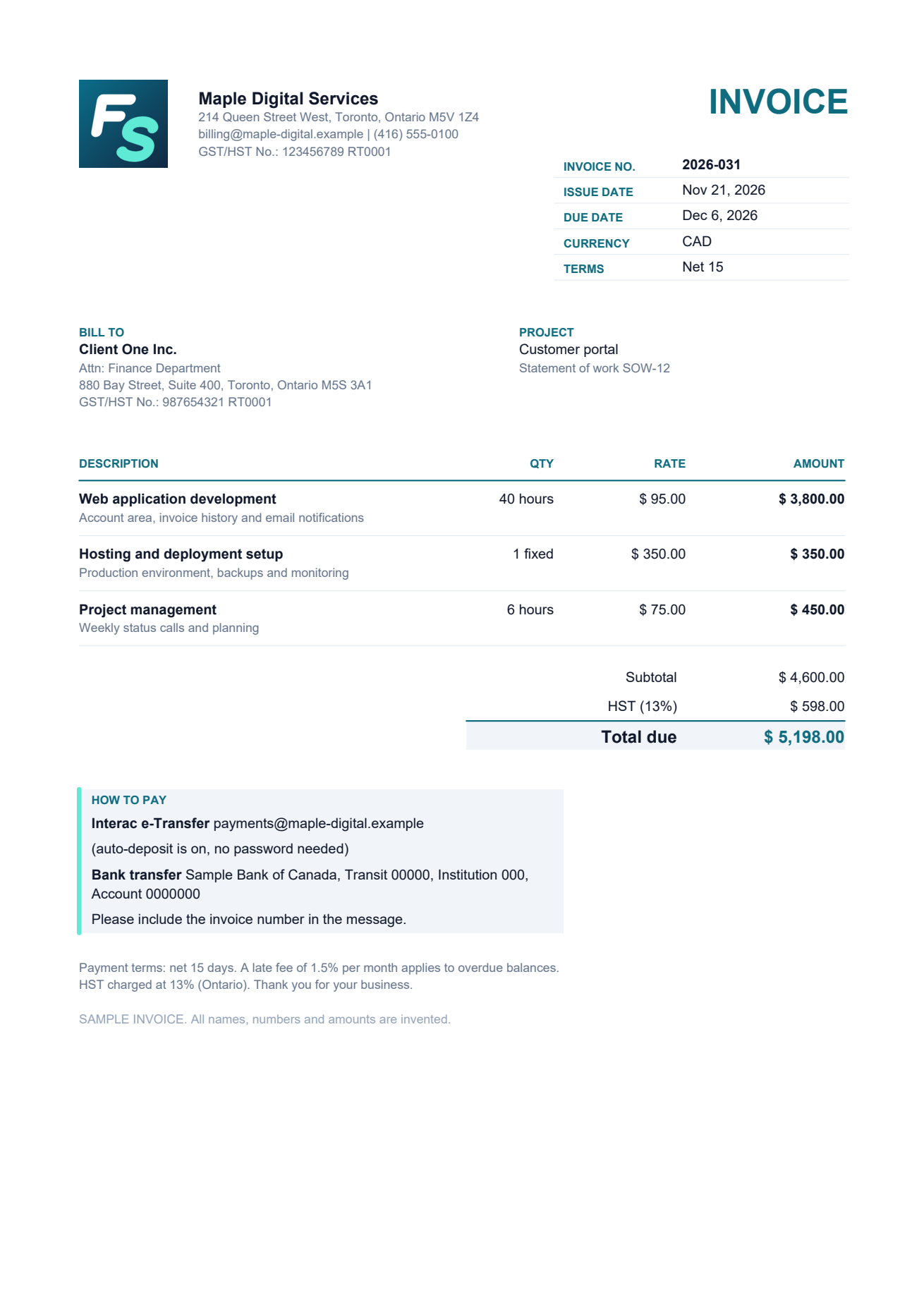
Here is a sample invoice made in FlowSawa, with GST/HST, a due date and a clear way to pay. All names and numbers are invented.
Number your invoices in order
Use one numbering series with no gaps or repeats, such as 1001, 1002, 1003. It keeps your records clear and makes an audit much easier.
Get paid faster
- Send the invoice the day the work is done.
- Write clear terms, such as "Due in 15 days".
- Make paying easy: list every way a client can pay you.
- Send a friendly reminder the day after the due date, then again a week later.
Quick answers
Do I need to show my GST/HST number on invoices?
If you are registered and the invoice is $100 or more, yes. Business clients need it to claim their input tax credits.
What should an invoice of $500 or more show?
Your name, the date, the total, your GST/HST registration number and the tax charged, plus the client's name, the payment terms and a description of what you sold.
How should I number my invoices?
Use one series in order with no gaps or repeats, such as 1001, 1002, 1003.
Keep it all in one place
FlowSawa keeps your expenses, receipts and invoices together, with GST/HST worked out for you.
Join the waitlist